<?xml version="1.0" encoding="UTF-8" standalone="yes"?>
		<rss version="2.0"
			xmlns:ezplug="http://ezplug.usu.edu/news/">
		   <channel>
			  <title>Office of Research and Graduate Studies - News</title>
			  <link>http://rgs.usu.edu/htm/news</link>
			  <description></description>
			  <language>en-us</language>
			  <lastBuildDate>Thu, 28 Mar 2013 00:00:00 MST</lastBuildDate>
				
			
			  <item>
				 
				 <title> Research Week 2013 recognizes USU&amp;#8217;s best faculty and student researchers</title>
				 <link>http://rgs.usu.edu/htm/news/articleID=19776</link>
				 <description>
				 	<![CDATA[
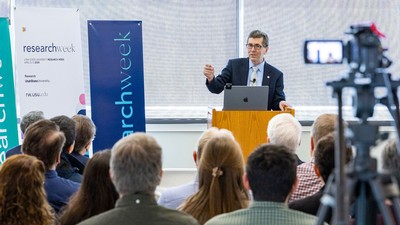
				 		&lt;p&gt;Utah State University&amp;rsquo;s ninth annual Research Week, to be held Apr. 8-12, will feature longstanding popular events, as well as new highlights. The weeklong celebration will highlight faculty, graduate and undergraduate researchers, scholars, and artists with themed days focusing on different aspects of research.&lt;/p&gt;
&lt;p&gt;&amp;ldquo;USU&amp;rsquo;s position as the state&amp;rsquo;s land-grant institution makes research a vital component of our mission,&amp;rdquo; said Mark McLellan, vice president for research and dean of the School of Graduate Studies. &amp;ldquo;It&amp;rsquo;s a pleasure to spend an entire week celebrating the hundreds of faculty and students who have been engaged in projects this year.&amp;rdquo;&lt;/p&gt;
&lt;p&gt;Research Week&amp;rsquo;s most attended events are the student symposia: Student Showcase (on Thurs., Apr. 11) and the Graduate Research Symposium (on Fri., Apr. 12). New this year will be Ignite, an evening event to bridge those two groups.&lt;/p&gt;
&lt;p&gt;&amp;ldquo;We know that the benefits of research extend far beyond the results that appear on students&amp;rsquo; posters and oral presentations,&amp;rdquo; said Scott Bates, associate vice president for graduate and undergraduate research. &amp;ldquo;Ignite will provide a light-hearted atmosphere for students to share more of those intangible benefits.&amp;rdquo;&lt;/p&gt;
&lt;p&gt;Ignite is a national speaking event with the tagline, &amp;ldquo;enlighten us, but make it quick.&amp;rdquo; Instead of the 15-20 minutes allotted to traditional oral presentations, speakers are held to five minutes, with slides that automatically advance.&lt;/p&gt;
&lt;p&gt;Ignite will be held in the TSC Skyroom on the evening of Thurs., Apr. 11. Attendees will be served beverages and compete in a collaborative &amp;ldquo;build&amp;rdquo; project before USU graduate and undergraduate researchers share the lighter side of their discoveries in five minutes or less.&lt;/p&gt;
&lt;p&gt;Preference for Ignite attendance will be given to those presenting at Student Showcase and the Graduate Research Symposium, though anyone will be able to request a ticket.&lt;/p&gt;
&lt;p&gt;&amp;ldquo;We are pleased to be involved with the Ignite speaking series, especially after the positive response we received with TEDxUSU last fall,&amp;rdquo; said Bates. &amp;ldquo;The success of these events demonstrates how USU research extends beyond the published results into real solutions and insights.&amp;rdquo;&lt;/p&gt;
&lt;p&gt;Due to its great success and overwhelming response last year, the Research Recognition Night will be held again for the second time. It will take place on Monday, April 8 at the Riverwoods Conference Center in Logan, as part of Faculty Research Day.&lt;/p&gt;
&lt;p&gt;The by-invitation event will recognize college researchers of the year, large grant recipients, USU&amp;rsquo;s Graduate Mentor of the Year and the D. Wynne Thorne Career Research Award recipient. Video previews featuring college researchers of the year will be shown and the public will have the opportunity to view the videos throughout the summer.&lt;/p&gt;
&lt;p&gt;&amp;ldquo;These faculty members have been nominated by each department for their excellence and past accomplishments,&amp;rdquo; said McLellan. &amp;ldquo;They are the cream of the crop within the Utah State&amp;rsquo;s research community and we want them to know that we value their contributions to the university.&amp;rdquo;&lt;/p&gt;
&lt;p&gt;In addition to these events, other events such as the D. Wynne Thorne Lecture, Faculty Book Celebration, and workshops will also take place during Research Week.&lt;/p&gt;
&lt;p&gt;- &lt;em&gt;Nadiah Johari&lt;/em&gt;&lt;/p&gt;
&lt;p&gt;&lt;/p&gt;
&lt;p&gt;&lt;/p&gt; 
				 	]]>
				 </description>
				 <ezplug:articleBody>Utah State University’s ninth annual Research Week, to be held Apr. 8-12, will feature longstanding popular events, as well as new highlights. </ezplug:articleBody>
				 <pubDate>Thu, 28 Mar 2013 00:00:00 MST</pubDate>
				 <guid>http://rgs.usu.edu/htm/news/articleID=19776</guid>
			  </item>
			  <item>
				 
				 <title> Graduate Research Symposium offers new presentation opportunity</title>
				 <link>http://rgs.usu.edu/htm/news/articleID=20111</link>
				 <description>
				 	<![CDATA[
				 		&lt;p&gt;Developmental presentation, or DEV PRES, is a new presentation opportunity for graduate students to present their research and receive feedback without the added pressures of a grade or broader professional consequences.&lt;/p&gt;
&lt;p&gt;Since DEV PRES serves as an opportunity to improve presentation skills, presenters will not be eligible for awards given during the Graduate Research Symposium. Students who apply to make a DEV PRES will be asked to meet the following requirements:&lt;br /&gt;
&amp;bull;	Make a 10-12 minute presentation on their work.&lt;br /&gt;
&amp;bull;	Answer questions about their work for one to five minutes.&lt;/p&gt;
&lt;p&gt;An LCD projector and computer will be available, but not required. Attendees such as other presenters, graduate students and faculty will be asked to provide feedback via a standardized rubric. All feedback collected at the end of each session is private and confidential.&lt;/p&gt;
&lt;p&gt;&amp;ldquo;We want to train our students to become excellent public speakers because communication skills is a valuable asset for researchers,&amp;rdquo; said Scott Bates, associate vice president for undergraduate and graduate research. &amp;ldquo;The ability to communicate your research findings to the public is as important as doing research.&amp;rdquo;&lt;/p&gt;
&lt;p&gt;Students will be provided with the following within a few days of presenting:&lt;br /&gt;
&amp;bull;	A video recording of their presentation for their review and use. Videos will not be edited, nor publicly archived.&lt;br /&gt;
&amp;bull;	Rubric-based feedback from multiple sources, that includes open-ended comments as well as evaluation scores on presentation style, presentation content and slides review.&lt;/p&gt;
&lt;p&gt;Submissions for USU&amp;rsquo;s Graduate Research Symposium are now open. The symposium, which will take place during Research Week on April 12, will include a poster session, oral presentations and training workshops. The deadline for submissions is March 1. The event provides opportunities for graduate students to develop their professional presentation skills and support the success in graduate school and beyond.&lt;/p&gt;
&lt;p&gt;Utah State University&amp;rsquo;s ninth annual Research Week, to be held Apr. 8-12, will feature longstanding popular events, as well as new highlights. The weeklong celebration will highlight faculty, graduate and undergraduate researchers, scholars and artists with themed days focusing on different aspects of research.&lt;/p&gt;
&lt;p&gt;- &lt;em&gt;Nadiah Johari&amp;nbsp;&lt;/em&gt;&lt;/p&gt; 
				 	]]>
				 </description>
				 <ezplug:articleBody>Developmental presentation, or DEV PRES, is a new presentation opportunity for graduate students to present their research and receive feedback without the added pressures of a grade or broader professional consequences. </ezplug:articleBody>
				 <pubDate>Fri, 08 Feb 2013 00:00:00 MST</pubDate>
				 <guid>http://rgs.usu.edu/htm/news/articleID=20111</guid>
			  </item>
			  <item>
				 
				 <title> Passion for engineering prompts Presidential Doctoral Research Fellow to pursue degrees in three different countries</title>
				 <link>http://rgs.usu.edu/htm/news/articleID=20098</link>
				 <description>
				 	<![CDATA[
				 		&lt;p&gt;&lt;img src=&quot;/plugins/work/blogger/14/images/PDRFPic.jpg&quot; width=&quot;200&quot; height=&quot;200&quot; align=&quot;left&quot; alt=&quot;&quot; /&gt;USU&amp;rsquo;s Presidential Doctoral Research Fellow (PDRF) Pratima Labroo developed an interest in biology and mathematics in high school and decided to pursue biological engineering, an area that integrates both fields of study, she said.&lt;/p&gt;
&lt;p&gt;&amp;ldquo;I entered an engineering college to gain knowledge about the design of sophisticated and high performance systems,&amp;rdquo; said Labroo. &amp;ldquo;I studied hard and tried harder not to lose touch with biology that I love so much. In my second year, I discovered biological engineering and the more I read about it, the more confident I felt that this is where my future lies.&amp;rdquo;&lt;/p&gt;
&lt;p&gt;Labroo hails from India. She graduated from SMVD University in India in 2009 with a bachelor&amp;rsquo;s degree in electronics and communication engineering.  She worked on projects covering topics such as microprocessor and microcontroller programming, analog and digital circuit design, and sensor networks, all of which helped her understand electronics at hardware and software level.&lt;/p&gt;
&lt;p&gt;She then attended the University of Dundee, UK in 2010 and completed her master&amp;rsquo;s degree in biomedical engineering. She said that she acquired a sound overall knowledge of engineering principles, preliminary designing, as well as the building and testing of mechanical system for healthcare and clinical applications.&lt;/p&gt;
&lt;p&gt;Labroo said she first heard about USU when she saw a posting in the department of biological engineering while searching for a PhD position in the biosensors area.&lt;/p&gt;
&lt;p&gt;&amp;ldquo;At that time, the department was looking for people who are highly motivated, disciplined and have the ability to multitask,&amp;rdquo; she said. &amp;ldquo;While going through the details of the various research groups, I realized that the doctoral program at the department of biological engineering at Utah State University offered the flexibility, atmosphere and the research exposure that I was looking for.&amp;rdquo;&lt;/p&gt;
&lt;p&gt;She said it is an honor to be selected as a PDRF and she is looking forward to the things that come with being a PDRF.&lt;/p&gt;
&lt;p&gt;&amp;ldquo;This opportunity will allow me to be involved in research at a deeper level and gain experience in teaching and coaching undergraduate students, all of which will help me in my future career in academia,&amp;rdquo; she said.&lt;/p&gt;
&lt;p&gt;The Presidential Doctoral Research Fellowships are awarded to incoming doctoral students. The fellowships are intended to attract elite graduate students to Utah State University, a vital part of building a leading research institution. To help enhance their on-campus success, fellows will be required to meet additional expectations, including grantsmanship and ethics training, pursuit of external support, research presentations, teaching requirements and mentoring opportunities. For more information about the fellowship, visit the &lt;a href=&quot;http://rgs.usu.edu/studentresearch/htm/graduate-research-opportunities/pdr-fellows/&quot;&gt;Presidential Doctoral Research Fellow&lt;/a&gt; website.&lt;/p&gt;
&lt;p&gt;- &lt;em&gt;Nadiah Johari&amp;nbsp;&lt;/em&gt;&lt;/p&gt; 
				 	]]>
				 </description>
				 <ezplug:articleBody>USU’s Presidential Doctoral Research Fellow (PDRF) Pratima Labroo developed an interest in biology and mathematics in high school and decided to pursue biological engineering, an area that integrates both fields of study, she said.</ezplug:articleBody>
				 <pubDate>Fri, 08 Feb 2013 00:00:00 MST</pubDate>
				 <guid>http://rgs.usu.edu/htm/news/articleID=20098</guid>
			  </item>
			  <item>
				 
				 <title> USU faculty, staff and students are encouraged to submit inventions for potential global partnership opportunities</title>
				 <link>http://rgs.usu.edu/htm/news/articleID=20091</link>
				 <description>
				 	<![CDATA[
				 		&lt;p&gt;USU&amp;rsquo;s Office of Commercialization and Regional Development invites faculty, staff and students to submit their inventions for possible patent and development assistance. An invention or intellectual property is defined as &amp;ldquo;the discovery or creation of a new material (either manufactured product or a new composition or matter), a new process, a new use for an existing material, or any improvements of any of these.&amp;rdquo;&lt;/p&gt;
&lt;p&gt;The Intellectual Property (IP) Services is a university unit within the Office of Commercialization and Regional Development that is fully dedicated to helping USU inventors protect their intellectual property. The IP Service team consists of two in-house IP attorneys as well as a patent and trademark office agent.&lt;/p&gt;
&lt;p&gt;Faculty, staff and students can submit invention disclosures using the USU Inventor Portal. The IP Services will evaluate disclosure based on market, patent and commercial potential.&lt;/p&gt;
&lt;p&gt;&amp;ldquo;If the intellectual property has market value, we&amp;rsquo;d like to commercialize that,&amp;rdquo; said Robert Behunin, vice president for commercialization and regional development. &amp;ldquo;We&amp;rsquo;d like to partner with industry leaders to make sure that the intellectual property succeed in the marketplace.&amp;rdquo;&lt;/p&gt;
&lt;p&gt;The following services are offered by IP Services to manage the commercial aspects of creative works at USU and assist inventors in understanding technology transfer:&lt;br /&gt;
&amp;bull;	creating the appropriate forms and procedures for disclosing creative works&lt;br /&gt;
&amp;bull;	helping inventors complete these forms and review all disclosures&lt;br /&gt;
&amp;bull;	evaluating the legal validity and commercial appeal of potential inventions and ideas&lt;br /&gt;
&amp;bull;	formulating development plans for meritorious creative works&lt;br /&gt;
&amp;bull;	marketing the concepts to private industry&lt;br /&gt;
&amp;bull;	facilitating the formation of new business&lt;br /&gt;
&amp;bull;	assisting in securing development funding for promising technologies&lt;/p&gt;
&lt;p&gt;Behunin said that over the last two years, USU has successfully commercialized the inductive power transfer and the Aggie Bus, USU&amp;rsquo;s wirelessly charged electric bus. He also said faculty, staff and students are welcome to visit the Office of Commercialization and Regional Development to get more information on IP Services.&lt;/p&gt;
&lt;p&gt;&amp;ldquo;We&amp;rsquo;d love to answer your questions and help you turn your protected valuable IP into a viable and marketable product that really could, in some ways, change the world,&amp;rdquo; he said.&lt;/p&gt;
&lt;p&gt;IP Services managers will support USU community members as they disclose their novel technologies and assist in technology commercial development. They will also ensure that all obligations to sponsoring entities are met. For more information on IP services, visit &lt;a href=&quot;http://ipso.usu.edu/htm/about&quot;&gt;http://ipso.usu.edu/htm/about&lt;/a&gt;.&lt;/p&gt;
&lt;p&gt;- &lt;em&gt;Nadiah Johari&amp;nbsp;&lt;/em&gt;&lt;/p&gt; 
				 	]]>
				 </description>
				 <ezplug:articleBody>USU’s Office of Commercialization and Regional Development invites faculty, staff and students to submit their inventions for possible patent and development assistance. </ezplug:articleBody>
				 <pubDate>Thu, 07 Feb 2013 00:00:00 MST</pubDate>
				 <guid>http://rgs.usu.edu/htm/news/articleID=20091</guid>
			  </item>
			  <item>
				 
				 <title> USU takes safety measures to prevent potential spills that could result in environmental harm</title>
				 <link>http://rgs.usu.edu/htm/news/articleID=20090</link>
				 <description>
				 	<![CDATA[
				 		&lt;div class=&quot;contentTemplateWrapper&quot;&gt;
&lt;div class=&quot;twoThirdsCol left&quot;&gt;
&lt;p&gt;USU&amp;rsquo;s Environmental Health and Safety division in the Office of Research and Graduate Studies is currently updating USU&amp;rsquo;s Spill Prevention, Control and Countermeasure Plans (SPCC) to determine the potential escape of organic materials from the campus to the waterways of the country.&lt;/p&gt;
&lt;p&gt;The SPCC is a law enacted by the Environmental Protection Agency in response to some of the spills that have been recurring in the United States, said Eric Jorgensen, assistant director of EHS. At USU, EHS is responsible for taking inventory of all containers that contain more than 55 gallons of organic materials. The locations for these containers are mapped and the amount of organic materials within each container is recorded. This data gathering process is important to ensure that the updated plan includes all the steps that should be taken if a spill occurs.&lt;/p&gt;
&lt;p&gt;&amp;ldquo;We have a whole bunch of containers scattered throughout campus,&amp;rdquo; said Jorgensen. &amp;ldquo;Every building on campus has an emergency generator and every generator contains at least 200 gallons of diesel fuel. We are doing our best to ensure that organic materials do not leak from their containers.&amp;rdquo;&lt;/p&gt;
&lt;p&gt;&amp;ldquo;The back up generators are essential to make sure that we don&amp;rsquo;t lose any research in case the power goes out,&amp;rdquo; said Steve Bilbao, director of EHS.&lt;/p&gt;
&lt;p&gt;In addition to generators, EHS is also keeping track of the following inventory:&lt;br /&gt;
&amp;bull;	Diesel fuel in storage tanks connected to generators&lt;br /&gt;
&amp;bull;	Dielectric fluid in transformers as coolant&lt;br /&gt;
&amp;bull;	Hydraulic fluid to move elevators &lt;br /&gt;
&amp;bull;	Cooking oil used by eateries on campus&lt;br /&gt;
&amp;bull;	All other permanent, non-mobile fuel tanks (motor pool, facilities, farms, etc.)&lt;/p&gt;
&lt;p&gt;The Environmental Health and Safety Office is a service organization that provides expertise and advice for compliance with federal, state and local safety and health regulations, as well as current professional practices and guidelines.&lt;/p&gt;
&lt;p&gt;- &lt;em&gt;Nadiah Johari&amp;nbsp;&lt;/em&gt;&lt;/p&gt;
&lt;/div&gt;
&lt;div class=&quot;thirdCol fluid&quot;&gt;
&lt;div class=&quot;thirdCol fluid&quot;&gt;&lt;img src=&quot;/plugins/work/blogger/14/images/GeneratorPlug.jpg&quot; width=&quot;200&quot; height=&quot;200&quot; alt=&quot;&quot; /&gt;&lt;/div&gt;
&lt;p style=&quot;font-size:9px;color:#333&quot;&gt;The emergency generator shown in the picture above contains 200 gallons of diesel fuel. An EHS work-study student is recording information such as the size of the container, the location as well as other information&lt;/p&gt;
&lt;div class=&quot;thirdCol fluid&quot;&gt;&lt;img src=&quot;/plugins/work/blogger/14/images/Transformers002.jpg&quot; width=&quot;200&quot; height=&quot;200&quot; alt=&quot;&quot; /&gt;&lt;/div&gt;
&lt;p style=&quot;font-size:9px;color:#333&quot;&gt;These transformers contain between 700-1,500 gallons of diesel fuel&lt;/p&gt;
&lt;img src=&quot;/plugins/work/blogger/14/images/Widtsoe002.jpg&quot; width=&quot;200&quot; height=&quot;200&quot; alt=&quot;&quot; /&gt;&lt;br /&gt;
&lt;p style=&quot;font-size:9px;color:#333&quot;&gt;The emergency generator and transformers are housed underground, below the side walk between the TSC and Old Main building, on the west side of the Widtsoe Hall. The emergency generator is located right below the two students seen in the picture and the transformers are located under the grating on the right side of the picture&lt;/p&gt;
&lt;/div&gt;
&lt;p&gt;&lt;/p&gt;
&lt;/div&gt; 
				 	]]>
				 </description>
				 <ezplug:articleBody>USU’s Environmental Health and Safety division in the Office of Research and Graduate Studies is currently updating USU’s Spill Prevention, Control and Countermeasure Plans (SPCC) to determine the potential escape of organic materials from the campus to the waterways of the country. </ezplug:articleBody>
				 <pubDate>Thu, 07 Feb 2013 00:00:00 MST</pubDate>
				 <guid>http://rgs.usu.edu/htm/news/articleID=20090</guid>
			  </item>
			  <item>
				 
				 <title> Utah State will host the 7th Annual Utah Conference on Undergraduate Research in February</title>
				 <link>http://rgs.usu.edu/htm/news/articleID=20092</link>
				 <description>
				 	<![CDATA[
				 		&lt;p&gt;The seventh annual Utah Conference on Undergraduate Research (UCUR) will be held at Utah State University on February 22, 2013. The conference, modeled after the National Conference on Undergraduate Research, is designed to showcase the best undergraduate work from students all over the state.&lt;/p&gt;
&lt;p&gt;&amp;ldquo;We are excited to organize this event at our campus this year,&amp;rdquo; said Scott Bates, associate vice president for undergraduate and graduate research. &amp;ldquo;We were surprised at the large number of abstracts that were submitted. This year will be the largest UCUR conference yet.&amp;rdquo;&lt;/p&gt;
&lt;p&gt;Undergraduates from all disciplines were invited to apply for the conference, which provides an excellent opportunity for students to present their work in a scholarly setting to other students, faculty, field specialists and community members. Participating institutions include Utah State University, Weber State University, University of Utah, Brigham Young University, Utah Valley University, Salt Lake Community College, Westminster College, Utah College of Applied Technology, Snow College, College of Eastern Utah and Dixie State College of Utah.&lt;/p&gt;
&lt;p&gt;&amp;ldquo;We&amp;rsquo;ve come a long way since we started UCUR six years ago,&amp;rdquo; said Mark McLellan, vice president for research and dean of the School of Graduate Studies. &amp;ldquo;Year after year, these undergraduate researchers never fail to impress us with their superior scientific skills and their ability to conduct top notch research projects. As the research industry continues to evolve, these students are ceaselessly obtaining new findings and developing solutions which could contribute to real world issues.&amp;rdquo;&lt;/p&gt;
&lt;p&gt;UCUR&amp;rsquo;s mission is to promote undergraduate research, scholarship and creative activity, done with the mentorship of a faculty member or others, through an annual conference. The conference is organized by a committee of representatives from educational institutions across the state. It celebrates academic, professional and personal achievements resulting from undergraduate research projects or creative endeavors. For more information about UCUR, visit &lt;a href=&quot;http://rgs.usu.edu/ucur&quot;&gt;rgs.usu.edu/ucur&lt;/a&gt;.&lt;/p&gt;
&lt;p&gt;- &lt;em&gt;Nadiah Johari&amp;nbsp;&lt;/em&gt;&lt;/p&gt; 
				 	]]>
				 </description>
				 <ezplug:articleBody>The seventh annual Utah Conference on Undergraduate Research (UCUR) will be held at Utah State University on February 22, 2013. The conference, modeled after the National Conference on Undergraduate Research, is designed to showcase the best undergraduate work from students all over the state. </ezplug:articleBody>
				 <pubDate>Thu, 07 Feb 2013 00:00:00 MST</pubDate>
				 <guid>http://rgs.usu.edu/htm/news/articleID=20092</guid>
			  </item>
			  <item>
				 
				 <title> Sunrise Session addresses water issues from a social science perspective</title>
				 <link>http://rgs.usu.edu/htm/news/articleID=19979</link>
				 <description>
				 	<![CDATA[
				 		&lt;p&gt;The primary cause of most water crises is social change, said Douglas Jackson-Smith, who gave a talk during the recently held Sunrise Session. His presentation, &amp;ldquo;The people puzzle: Using social sciences to address water sustainability challenges in Utah,&amp;rdquo; will explore how human behaviors, local organizations, norms, values and laws affect water use.&lt;/p&gt;
&lt;p&gt;&amp;ldquo;Patterns of water use are never &amp;lsquo;natural,&amp;rsquo; but are always a reflection of society,&amp;rdquo; he said. &amp;ldquo;Individuals are not the only &amp;lsquo;water actors.&amp;rsquo; Decisions made by businesses, water agencies and canal companies constrain options for individual water users.&amp;rdquo;&lt;/p&gt;
&lt;p&gt;Jackson-Smith said there are three ways that the social sciences can contribute to water issues: &lt;br /&gt;
&amp;bull;	Documenting actual water use behaviors: Surveys of water users and utility records suggest wide variation in behavior between residential neighborhoods and agriculture&lt;br /&gt;
&amp;bull;	Understanding water use behaviors and decision-making: Provide explanations for the wide variations in water behavior such as the type of irrigation system used &lt;br /&gt;
&amp;bull;	Shaping water use behavior through policy: The impacts of policy, information and education&lt;/p&gt;
&lt;p&gt;&amp;ldquo;We are good at the people side of things,&amp;rdquo; he said. &amp;ldquo;We do research on causal linkages and policy effectiveness, confront popular misconceptions and help others understand why things change or don&amp;rsquo;t change.&amp;rdquo;&lt;/p&gt;
&lt;p&gt;He said drier states like Utah utilize more water. The state&amp;rsquo;s projected population growth and climate change will affect water use, he said.&lt;/p&gt;
&lt;p&gt;Jackson-Smith will also talk about the innovative Urban Transitions and Aridregion Hydrosustainability (iUTAH) project, which explores how population growth, changing climate and land use affect water sustainability.  He is the co-investigator in this project.&lt;/p&gt;
&lt;p&gt;Jackson-Smith is a professor and director of graduate studies in sociology at Utah State University. He has twice been awarded the &amp;ldquo;Researcher of the Year&amp;rdquo; for the College of Humanities and Social Science and recently served on a National Research Council committee on Sustainable Agricultural Systems for the 21st Century. He is also a fellow for the Carsey Institute and was appointed to the Research Advisory Committee for the Meridian Institute AGree initiative.&lt;/p&gt;
&lt;p&gt;At USU&amp;rsquo;s Sunrise Sessions, faculty and students share their research with alumni, community and business leaders from the Salt Lake area. Held quarterly in downtown Salt Lake City, these early-morning presentations detail how USU research is addressing pressing issues such as the obesity epidemic and hearing loss in children. All are invited to attend these events at no charge, courtesy of the generous sponsorship by Regence Blue Cross Blue Shield. For more information about Sunrise Session, visit &lt;a href=&quot;http://rgs.usu.edu/sunrise/&quot;&gt;rgs.usu.edu/sunrise&lt;/a&gt;.&lt;/p&gt;
&lt;p&gt;- &lt;em&gt;Nadiah Johari&amp;nbsp;&lt;/em&gt;&lt;/p&gt; 
				 	]]>
				 </description>
				 <ezplug:articleBody>The primary cause of most water crises is social change, said Douglas Jackson-Smith, who gave a talk during the recently held Sunrise Session.</ezplug:articleBody>
				 <pubDate>Wed, 30 Jan 2013 00:00:00 MST</pubDate>
				 <guid>http://rgs.usu.edu/htm/news/articleID=19979</guid>
			  </item>
			  <item>
				 
				 <title> Governor encourages all Utahns to check their houses for Radon</title>
				 <link>http://rgs.usu.edu/htm/news/articleID=19872</link>
				 <description>
				 	<![CDATA[
				 		&lt;p&gt;In honor of Radon Action Month (January), Utah Governor Herbert is urging all State of Utah employees to test their homes for radon. Radon is the most common non-tobacco-related cause of lung cancer, and many Utah homes have dangerously high levels.&lt;/p&gt;
&lt;p&gt;&amp;quot;Utah has the lowest smoking rate in the country, yet lung cancer is the top cancer killer in the state, and radon is the leading cause of lung cancer among non-smokers. More than one in four Utah homes has dangerously high indoor radon levels,&amp;quot; said Governor Herbert in his message.&lt;/p&gt;
&lt;p&gt;Radon is a colorless, odorless, naturally-occurring radioactive gas that is emitted from uranium in the earth. As the uranium decays, it gives off tiny radon particles. When inhaled, these particles can damage the cells in the lining of the lungs. Long-term exposure to radon can lead to lung cancer.&lt;/p&gt;
&lt;p&gt;&amp;quot;I do think testing for radon is worth the effort,&amp;quot; said Steve Bilbao, directory of environmental health and safety at USU. &amp;quot;Radon levels can vary from house to house (even in the same neighborhood), depending on building construction and fill, so each individual house needs to be sampled.&amp;quot;&lt;/p&gt;
&lt;p&gt;Radon test kits are easy to use and can be purchased online or from most hardware stores. The Utah Department of Environmental Quality has test kits available for purchase by Utah residents for $7. The kits can be ordered through the DEQ website at &lt;a href=&quot;http://radon.utah.gov&quot;&gt;http://radon.utah.gov&lt;/a&gt;.&lt;/p&gt;
&lt;p&gt;To prevent radon-induced lung cancer, the Environmental Protection Agency and the U.S. Surgeon General recommend keeping indoor radon levels below 4.0 pCi/L. However, tests have shown that between 20 and 30 percent of Utah buildings have indoor radon levels at 4.0 pCi/L or higher.&lt;/p&gt;
&lt;p&gt;&amp;quot;When I moved to Utah last year,&amp;nbsp;I tested for radon at our house purchase,&amp;quot; said Mark McLellan, vice president for research and dean of the School of Graduate Studies. &amp;quot;We detected high levels of radon, so we had a mitigation system installed. It produced dramatic results leading to negligible levels.&amp;quot;&lt;/p&gt;
&lt;p&gt;USU&apos;s division of Environmental Health and Safety? will provide information about radon at the USU wellness fair on Jan. 31.&amp;nbsp;&lt;a id=&quot;fck_paste_padding&quot;&gt;?&lt;/a&gt;&lt;/p&gt;
&lt;p&gt;&amp;quot;EHS has expertise and equipment to do monitoring,&amp;quot; said Bilbao. &amp;quot;It can serve as a resource for employee questions regarding radon.&amp;quot;&lt;/p&gt; 
				 	]]>
				 </description>
				 <ezplug:articleBody>In honor of Radon Action Month (January), Utah Governor Herbert is urging all State of Utah employees to test their homes for radon. Radon is the most common non-tobacco-related cause of lung cancer, and many Utah homes have dangerously high levels.</ezplug:articleBody>
				 <pubDate>Tue, 22 Jan 2013 00:00:00 MST</pubDate>
				 <guid>http://rgs.usu.edu/htm/news/articleID=19872</guid>
			  </item>
		   </channel>
		</rss>